Your Ultimate Guide to Gay London


Last updated: May 2026 | Written by Sascha Pendigrast, Head of Operations at London Relocation — with first-hand experience helping LGBTQ+ clients relocate to and settle into London.
London is one of the most LGBTQ+-friendly cities in the world — and one of the most dynamic to keep up with. The scene in 2026 isn’t a single “gay village” but a network of distinct neighbourhoods: Soho for density and history, Vauxhall for late-night clubbing and Sunday institutions, and Dalston, Hackney and Shoreditch for the scene’s clearest innovation zone. Whether you’re visiting, considering a move, or have just arrived and want to find your people, this 2026 guide will walk you through the best areas, the venues that genuinely matter right now, the weekly rhythm of the scene, and the practical stuff most guides skip.
Is London LGBTQ+-Friendly?
Short answer
Yes — London is consistently ranked among the most LGBTQ+-friendly cities in the world. Same-sex marriage has been legal in England and Wales since 2014,[1] discrimination based on sexual orientation and gender identity is illegal under the Equality Act 2010,[2] and the city hosts one of Europe’s largest Pride parades — drawing around 1.5 million people in recent years.[3] London has visible queer communities in every corner, multiple historic LGBTQ+ neighbourhoods, and decades of activist and cultural infrastructure.
The legal picture is straightforward. In the UK:
- Same-sex marriage has been fully legal since 2014 (Scotland 2014, Northern Ireland 2020).
- Civil partnerships are available to same-sex and opposite-sex couples.
- Workplace discrimination on the basis of sexual orientation or gender identity is illegal.
- Public displays of affection are generally accepted in London, especially in central neighbourhoods and the East End. As anywhere, some outer boroughs and late-night situations call for normal city awareness.
- Adoption, IVF and surrogacy are accessible to same-sex couples, with the same legal status as opposite-sex couples.
The day-to-day picture is similarly positive: London’s 40% foreign-born population[4] and decades of progressive activism mean LGBTQ+ people are a visible, normal part of city life. That doesn’t mean prejudice has disappeared — hate crime reporting still exists for a reason — but as global cities go, London is genuinely one of the easiest places to live openly.
The Hottest LGBTQ+ Venues in London Right Now
If you only have a weekend, this is the shortlist of venues actually defining the London scene right now — based on our team’s own visits and current 2026 programming, rather than what older guidebooks still recommend out of habit.
The Best LGBTQ+ Areas in London
London’s queer life isn’t concentrated in one neighbourhood — and that’s a strength, not a weakness. Each area has its own personality, peak nights, and crowd. Here’s an honest breakdown of where to go and why.
Soho — The Historic Heart
Best for: First-time visitors, short trips, anyone wanting maximum density on minimum walking distance.
Soho is still the fastest way to “read” the London scene in one evening. Old Compton Street, Wardour Street and Rupert Street form a tight triangle of bars open from noon onwards, and you can comfortably walk between half a dozen venues in 15 minutes. The crowd is high-energy, drag-heavy, international and openly tourist-friendly.
- Comptons of Soho — the classic Old Compton Street pub, still daily and reliable.
- Admiral Duncan — Soho stalwart with strong symbolic weight as a community anchor.
- Ku Bar — multi-level bar that’s been a Soho fixture for decades.
- She Soho — one of the few dedicated lesbian/sapphic bars in central London.
- Heaven — technically just on the Charing Cross edge, but functionally part of Soho. Still London’s biggest gay superclub.
- Sweatbox Soho — 24/7 men-only sauna for those after a different kind of central energy.
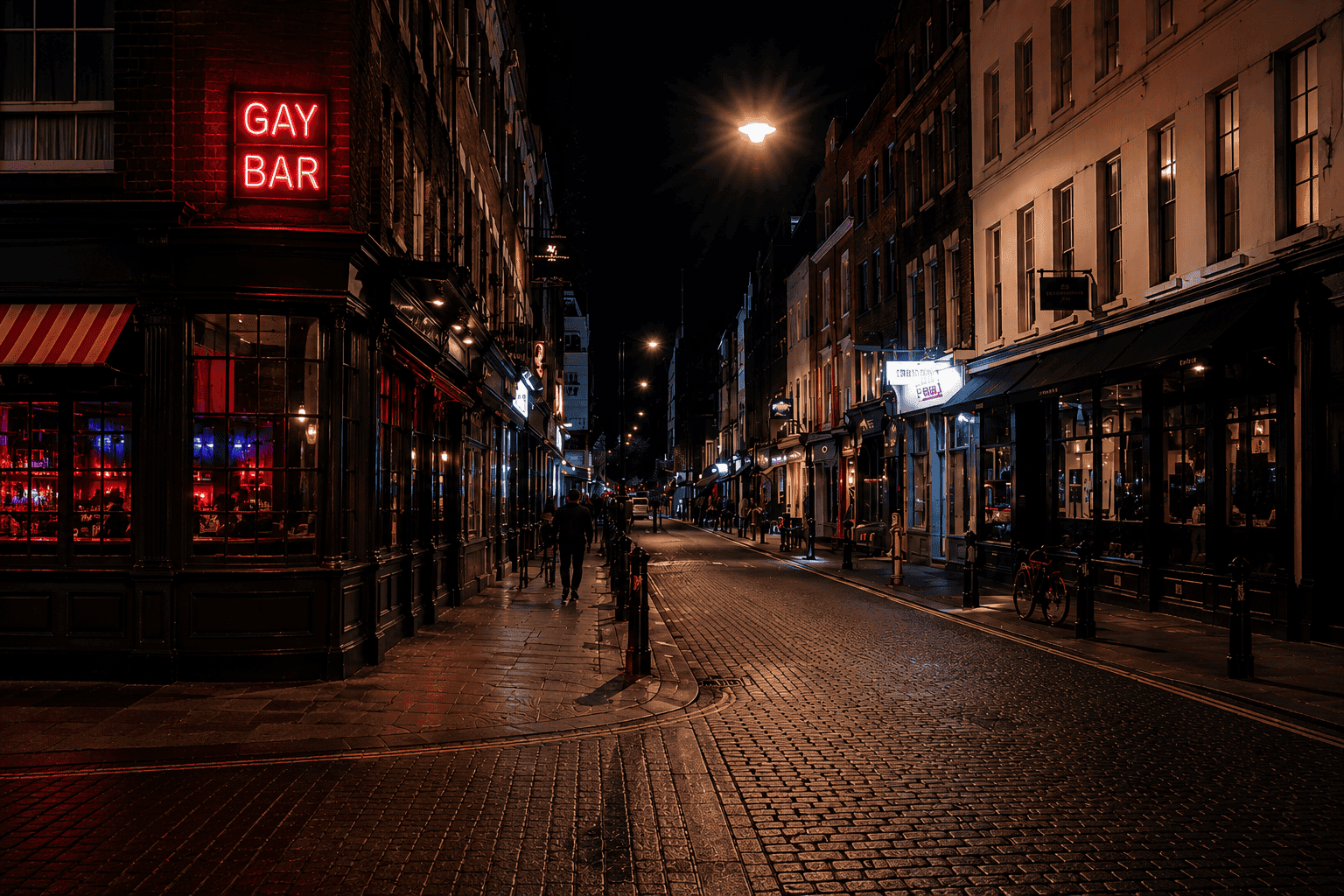
One thing worth knowing if you’ve been here before: the long-running G-A-Y Bar on Old Compton Street closed in October 2025 after more than 30 years.[5] The good news for the area is that the building reopens as a brand-new queer venue, COVEN: Headquarters, on 19 June 2026[6] — one of the year’s most-anticipated launches, and right in time for Pride weekend. The G-A-Y brand itself continues at Heaven through G-A-Y Thursdays and the Saturday night events.
The trade-off with Soho overall: it’s also the most expensive and most crowded part of the scene, especially on Friday and Saturday nights. If you want depth rather than density, you’ll need to head elsewhere.
Vauxhall & Kennington — Late Nights and Sunday Institutions
Best for: Serious clubbing, Sunday cabaret-to-disco institutions, dance-floor and fetish/leather-leaning scenes.
Vauxhall has a longer queer history than even Soho — and it’s where London still does its best late-night clubbing. Where Soho is bar-crawl friendly, Vauxhall is more “pick one venue and stay all night.” The area peaks on Sundays in a way no other part of the city matches.
- Royal Vauxhall Tavern (RVT) — possibly the most important queer institution south of the river. The Sunday Cabaret from 16:00–22:00 is a London ritual.[7] Heavy 2026 schedule of cabaret, pop, bear and special nights.
- Eagle London — masculine-coded, dance-driven, and home to the legendary Horse Meat Disco on Sundays.[8] Tickets at around £8 + booking fee; book in advance on big dates.
- Pleasuredrome (Waterloo) — 24/7 sauna and chill-out option for after-hours.
For a deeper dive on the neighbourhood itself, see our Vauxhall area guide.
Dalston, Hackney & Shoreditch — The Innovation Zone
Best for: Younger crowd, alternative scenes, trans/QTBIPOC-led programming, anyone wanting “right now” rather than heritage tourism.
This is where the most interesting queer programming in London is happening in 2026. East London has overtaken Soho as the centre of gravity for innovative, community-led queer nightlife. The crowd is younger, more creative, more politically engaged, and the venues are doing genuinely new things rather than refining old formats.
- The Divine (Dalston) — drag, cabaret and club nights with a strict queer-first door policy. Carries forward much of the team and energy of The Glory, the East London queer pub that closed in 2024.
- Dalston Superstore — café-bar-club open seven days a week. BodySwap on Wednesdays is the best community-led trans+ night in East London.
- The Roses of Elagabalus (Dalston) — designed as a “queer clubhouse” with a serious cocktail and dinner offering. Book in advance.
- La Camionera (Hackney, Well Street) — the city’s clearest sapphic/FLINTA-focused café-bar. Walk-ins only.
- The Common Press (Bethnal Green) — queer bookshop, café and events space. Best place to meet the scene during daylight hours.
- The White Swan — long-standing East End classic with its own basement club, still going strong in 2026.
For more on the neighbourhood, see our guides to Hackney and Shoreditch.
Clapham — South London’s Reliable Heart
Best for: Mid-range nights out, drag shows, a slightly older or more residential crowd, anyone living south of the river.
Clapham anchors South London’s queer life — much more residential than party-tourist, and that’s exactly its appeal. The Two Brewers is the area’s biggest draw, with a near-nightly programme of drag, cabaret and themed parties. Sunday’s Power of Four show is a long-running highlight. Clapham Common is also a long-time gathering point in good weather. See our Clapham area guide for more.
King’s Cross, Bankside & Bloomsbury — Culture and Community
Best for: A more sober, daytime, or culturally-focused side of queer London.
Not strictly a nightlife zone, but increasingly important to a well-rounded weekend:
- Queer Britain (King’s Cross) — the UK’s first dedicated LGBTQ+ museum, free entry and fully step-free. A brilliant context-setter before a night out.
- Gay’s the Word (Bloomsbury) — Britain’s oldest LGBTQ+ bookshop, still running events and author talks.
- London LGBTQ+ Community Centre (Bankside) — sober, intergenerational and increasingly central. Hosts the 50+ Trans and Non-Binary Group, the Queer Book Club and many other lower-pressure community formats.
Other Areas Worth Knowing
- Hampstead — the men’s and women’s bathing ponds on Hampstead Heath are long-established queer gathering points in summer. Quieter, residential, leafy.
- Islington and Highbury — strong LGBTQ+ residential community, lower-key social scene.
- Marylebone — home to City of Quebec, one of London’s oldest LGBTQ+ pubs, which reopened in 2025 after major investment.
- Greenwich and Blackheath — quieter southeast options with welcoming local communities.
- Camden — historically important. The much-loved Black Cap remains closed (campaigns to reopen continue), and Camden today is quieter for LGBTQ+ nightlife than it was 10–15 years ago, but still home to a vibrant residential community.
Sapphic, FLINTA & Lesbian Spaces in London
Dedicated sapphic, lesbian and FLINTA (women, trans, intersex, non-binary, agender) venues have historically been under-served in London compared with men’s bars — but 2026 has been a turning point. A small, intentional wave of new spaces has changed the picture significantly.
- La Camionera (Hackney) — the most-talked-about sapphic-focused café-bar in the city. Hosts regular Singles Nights including 30+, 40+, pan, and Black & POC-specific formats.
- Goldie Saloon — a newer sapphic/FLINTA-focused venue extending the same wave.
- She Soho — central London’s longest-running dedicated lesbian bar.
- Bottom Heavy (recurring at Dalston Superstore) — house and dance nights with a strong queer-women crowd.
- Hampstead Ponds — the Kenwood Ladies’ Pond on the Heath has been a queer-women gathering point for nearly a century.
If you’re moving as a queer woman, trans person or non-binary person, this matters: London now has dedicated spaces that aren’t just adjuncts to men-focused bars.
The Weekly Calendar: Best Nights to Go Out
London’s queer scene runs on a weekly rhythm, and a lot of the best programming is tied to specific nights. Show up on the wrong day and you’ll have a much flatter experience than you should:
Monday
Popcorn at Heaven — big student-leaning club night with house and R&B. Come early on term-time and bank holidays.
Tuesday
Hot Mess Karaoke at Two Brewers (Clapham) — camp, chaotic and cabaret-adjacent. Starts around 20:30; free before 21:00 on most dates.
Wednesday
BodySwap at Dalston Superstore — community-led trans+ club night, easily the best mid-week option in East London if you want community-first energy.
Thursday
G-A-Y Thursday at Heaven — long-running mid-week mainstream gay night. Often the smartest night for first-time visitors who want lower friction at the door.
Friday
Citywide weekend programming kicks off — The Divine, RVT, Eagle and Heaven all run major nights. Club Glitch at The Divine (monthly) is one of the strongest recurring queer dance parties.
Saturday
Peak weekend night across the city — biggest crowds at Heaven, Eagle, The Divine and Two Brewers. Soho is at its most intense between 22:00 and 02:00.
Sunday
Sunday Cabaret at RVT → Horse Meat Disco at Eagle — the most “London” queer night you can have. RVT cabaret runs 16:00–22:00; Horse Meat Disco runs 20:00 to 03:00/04:00. This is the institution.
Pro tip — pick the right night
Thursday is smartest, Friday/Saturday is biggest, Sunday is most London. If you only have one night, make it Sunday in Vauxhall — RVT’s cabaret straight into Horse Meat Disco at Eagle is the single most “London” queer night you can have, and nothing else in the city quite matches it.
Major LGBTQ+ Events in London 2026
If you’re planning a trip — or just want to make the most of a year in London — these are the big dates already locked in. Book accommodation and tickets early; Pride weekend in particular fills up months in advance.
- BFI Flare (LGBTQ+ Film Festival) — typically late March; check the BFI website for the 2026 programme.
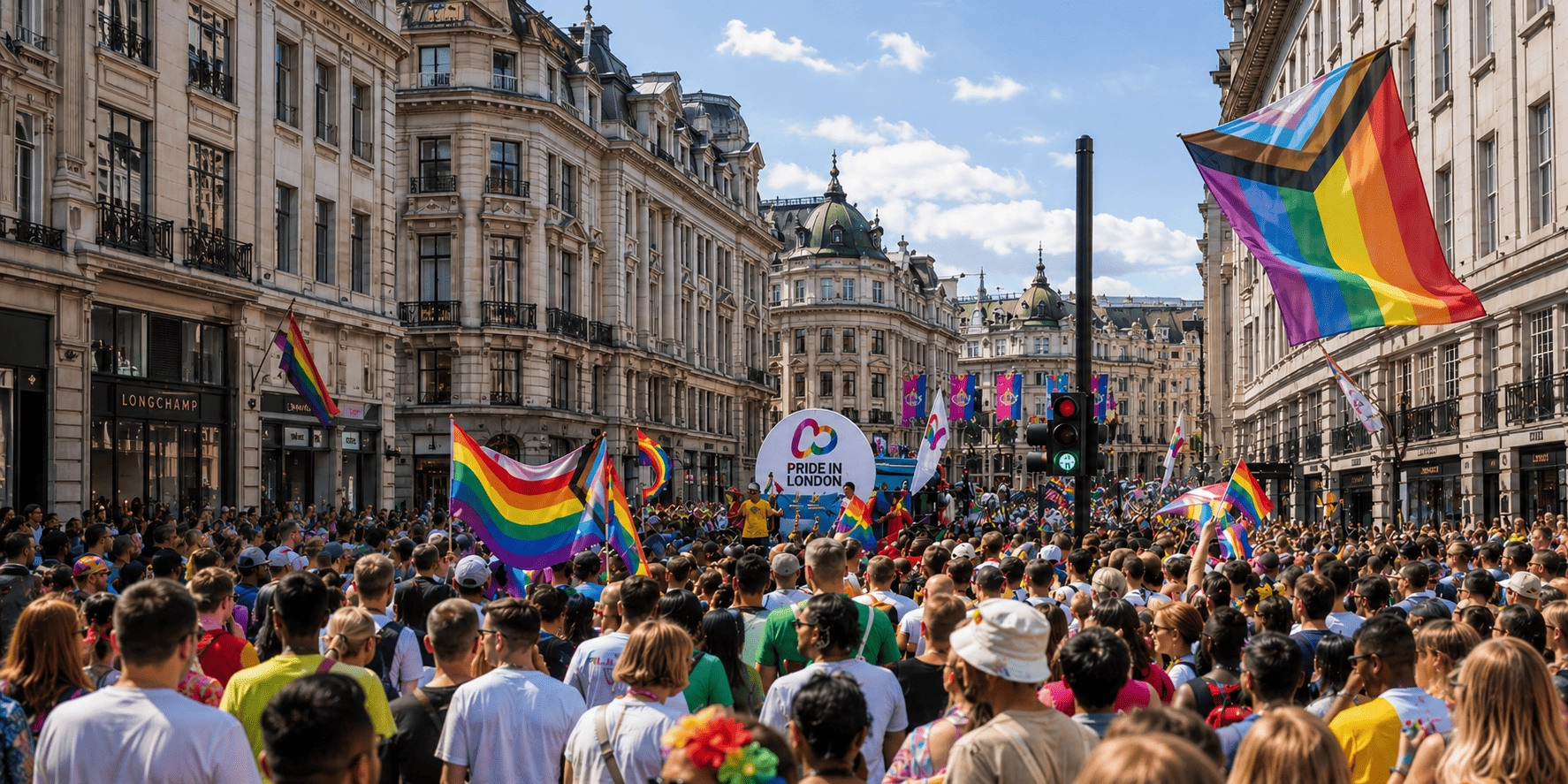
- Pride in London Parade — Saturday 4 July 2026, stepping off at noon from Hyde Park Corner, finishing in Whitehall. Pride weekend events run 2–6 July. Free entry to the parade and all official stages. Around 1.5 million people attended in recent years.[3]
- ADONIS Pride — Saturday 4 July 2026. London’s biggest underground queer rave brand throws its Pride flagship. Book tickets very early.[9]
- ADONIS Birthday — Saturday 5 September 2026.[9]
- Body Movements — Sunday 30 August 2026 in Southwark Park. A full-day open-air queer festival with multiple stages.[10]
- UK Black Pride — typically the Sunday after Pride in London; the largest celebration of LGBTQ+ people of African, Asian, Caribbean, Middle Eastern and Latin American descent in Europe.[11]
- Fringe! Queer Film & Arts Fest — autumn, East London. Takes over cinemas, galleries and venues across Dalston, Hackney and Shoreditch.
- LGBT+ History Month — every February, with events across the city. See our LGBT History Month events guide.
For more on Pride specifically, see our London Pride guide (we update this each year).
Where to Live as an LGBTQ+ Expat in London
Short answer
There’s no single “gay neighbourhood” to live in — and that’s a feature, not a bug. The most popular LGBTQ+-friendly residential areas in 2026 are Vauxhall and Kennington (for nightlife proximity), Clapham, Hackney and Dalston (younger, creative crowd), Islington (established residential community), and Hampstead (quieter, leafier). Realistically, almost every central and inner-London neighbourhood is openly welcoming.
One of the things many of our LGBTQ+ clients tell us they appreciate about London: you don’t have to live in “the gay area” to live openly. Same-sex couples are visible across the whole city, and the question is much more about lifestyle than safety. Here’s how to think about choosing:
- If you want nightlife on your doorstep: Vauxhall, Kennington, or Soho-adjacent areas like Bloomsbury and Fitzrovia.
- If you want a younger, creative, scene-led life: Hackney, Dalston, Shoreditch, Bethnal Green or Stoke Newington.
- If you want established LGBTQ+ residential community: Islington, Clapham, Hampstead, Highbury.
- If you want green space and a slower pace: Richmond, Greenwich, Blackheath, Wimbledon.
- If you’re moving as an American expat: Kensington, Chelsea, Fulham and Notting Hill all have large, open international LGBTQ+ communities. See our guides to expat life in London and living in London as an American.
For more context, our team has put together a dedicated guide to the best gay areas in London, plus broader pieces on the best places to live in London, best areas for families, and best areas for young professionals.
Practical Tips: Safety, Etiquette & Getting Around
Door Policies and Etiquette
London’s best queer venues in 2026 are actively curated. That’s a good thing — but it means door policy isn’t just about dress code, it’s about protecting the room’s purpose. Two practical things to know:
- Dalston Superstore explicitly prioritises its LGBTQIA+ guests, runs Challenge 25, and has full bag search and body searches on Friday/Saturday nights. They also have welfare staff on late weekend nights.
- The Divine has a zero-tolerance policy on homophobia, transphobia, racism and misogyny — and doesn’t admit office, stag or hen parties.
If you’re new to the scene: don’t be the “main character tourist” in a room locals are actively protecting. Read the venue’s vibe, follow staff instructions, and ask before photographing anyone.
Ask for Angela
“Ask for Angela” is now rolled out across licensed venues in London. If you feel uncomfortable or unsafe in a bar or club, ask any staff member for “Angela” — they’re trained to discreetly help you get out of the situation, call a taxi, or contact someone.[12]
Sauna and Sex-Positive Venue Etiquette
In sexualised or sex-positive spaces (Sweatbox, Pleasuredrome), consent is meant literally — not symbolically. Sweatbox explicitly publishes that no sexual contact may take place without consent, and encourages guests to report violations directly to staff.
Phone Theft Awareness
This is a genuine 2026 concern in central London. The Metropolitan Police has run specific Friday-night operations targeting phone theft. In practice: don’t stand at the kerb with your phone visible, especially around the West End, Soho, and big stations. Use an inside pocket or closed crossbody bag, and check directions indoors or against a wall rather than on the kerb.
Accessibility
Accessibility is genuinely uneven across the queer scene. Many of the most interesting 2026 venues are in older buildings with vaulted basements, stairs and cellar dance floors. If access matters to you, plan venue by venue, not just area by area:
- Step-free / fully accessible: Queer Britain (King’s Cross), The Common Press ground floor.
- Partially accessible: The Divine (ground floor only — no lift to basement), Dalston Superstore (ramped entrance, accessible ground floor, basement club via stairs only), RVT (small ramp at main entrance, but no fully accessible toilets), The Roses of Elagabalus (ramped main bar, dining and performance areas; basement bar via narrow stairs only).
- Not fully accessible: Sweatbox (multiple levels without lift), many older Soho pubs.
Getting Around at Night
The single biggest difference between a good night and a logistics disaster: the Night Tube. On Friday and Saturday nights, the Night Tube runs on the Central, Jubilee, Northern, Piccadilly and Victoria lines, plus night services on the Windrush line — particularly useful for getting to East London and Dalston.[13]
One critical thing to know: Vauxhall station is not a Night Tube stop. If you’re partying in Vauxhall, plan for night buses, taxis, or to leave before the last Victoria Line train (around 00:30).
Pay with contactless or Oyster — TfL’s fare cap runs from 04:30 one day to 04:29 the next, which works in your favour if you hop between Soho, Dalston and Vauxhall in a single night. Bus and tram fares are frozen at £1.75 until 5 July 2026, with a daily cap of £5.25.[14] For a multi-stop night, contactless is almost always smarter than single tickets. See our full guide to transport in London.
Apps and Resources
The tools and outlets actually used by the London scene in 2026:
- QX Magazine — long-running London queer media; still the best for listings, club nights and previews.
- Boyz Magazine — community news, events, interviews and culture coverage.
- Time Out London — increasingly strong queer nightlife coverage, especially their annual “best bars and club nights” lists.
- Attitude — magazine and online guides, including a regularly updated London scene guide.
- OutSavvy — the go-to ticketing platform for queer events in the UK; great for finding what’s on tonight.
- Apps: Grindr, Hinge, Feeld, Lex (text-based queer/sapphic) and HER (sapphic) are all widely used in London.
- Switchboard (formerly London Gays and Lesbians Switchboard) — still operates a national helpline and chat service for LGBTQ+ support.
How London Relocation Helps LGBTQ+ Movers
We’ve helped LGBTQ+ clients relocate to London for over two decades — single professionals, same-sex couples, families, and people transitioning who want to do that in a city that supports them. Our dedicated LGBTQ+ relocation service covers:
- Neighbourhood matching — finding the right area for your lifestyle, not the stereotyped “gay area” assumption.
- Landlord and agent vetting — we work with relationships built over years; you won’t be sent to landlords who have a track record of issues with LGBTQ+ tenants.
- One-day accompanied home search — view 6–8 carefully shortlisted properties in a single trip.
- Remote home search — when you can’t be in London in person.
- Settling-in service — registration, utility setup, council tax, GP registration and everything else.
- Community introductions — pointing you toward the right local groups, sports leagues, faith communities or social clubs based on what you’re looking for.
Frequently Asked Questions
How many LGBTQ+ people live in London?
The Office for National Statistics’ most recent figures put the LGB+ population of England and Wales at around 3.8% of adults aged 16+, with London consistently among the regions with the highest concentration — recent surveys have put London’s LGB+ adult population at around 4–5%, equivalent to several hundred thousand people.[15] These figures don’t fully capture trans, non-binary and intersex populations, which are surveyed separately and often under-counted. In practice, London has one of the largest and most visible queer populations of any city in Europe.
Is London safe for LGBTQ+ travellers in 2026?
Generally yes. London consistently ranks among the safest major cities in the world for LGBTQ+ travellers, with strong legal protections, visible communities, and accepting attitudes across most of central and inner London. As with any major city, exercise normal awareness — especially around phone theft in central nightlife districts (a genuine 2026 issue) and in unfamiliar areas late at night.
What is the best gay area in London?
There’s no single “best” — it depends on what you want. Soho is best for first-time visitors and bar density. Vauxhall is best for late-night clubbing and Sunday institutions. Dalston, Hackney and Shoreditch are best for younger, more alternative scenes. Clapham is best for reliable South London nights out.
Is Soho still the centre of gay London?
Yes and no. Soho is still the historic heart and the easiest place to “read” the scene quickly — Old Compton Street remains a queer landmark. But the most interesting innovation in 2026 is happening in East London (Dalston, Hackney) and the Sunday cabaret-to-disco institution runs out of Vauxhall, not Soho. A complete picture of gay London now requires all three.
Is G-A-Y Bar still open?
No. G-A-Y Bar closed in October 2025 after more than 30 years on Old Compton Street. The building reopens as a new venue, COVEN: Headquarters, on 19 June 2026. G-A-Y’s long-running club nights at Heaven (G-A-Y Thursdays and the Saturday night events) continue.
What are the best lesbian or sapphic bars in London?
The most prominent in 2026 are La Camionera (Hackney), Goldie Saloon, and She Soho in central London. Recurring nights like Bottom Heavy at Dalston Superstore also draw strong queer-women crowds. The sapphic/FLINTA scene in London has expanded significantly in recent years.
When is Pride in London 2026?
The Pride in London parade takes place on Saturday 4 July 2026, stepping off at noon from Hyde Park Corner and finishing on Whitehall. The wider Pride weekend runs 2–6 July 2026, with events across Soho, Vauxhall and the West End. Entry to the parade and all official stages is free.
Are there gay-friendly schools, doctors and services in London?
Yes. The NHS has clear LGBTQ+ inclusive guidelines, GP practices are required to provide non-discriminatory care, and most private practices in central London have extensive LGBTQ+ patient bases. State and private schools in London are generally well ahead of the UK average on inclusivity. Specific LGBTQ+-focused services include the gender clinics, sexual health services like 56 Dean Street, and counselling through Switchboard and MindOut.
Can same-sex couples adopt or use IVF/surrogacy in London?
Yes. Same-sex couples in the UK have the same legal rights to adopt, foster, use IVF and engage with surrogacy (under UK law, the surrogate has legal motherhood at birth, with parental orders typically transferring legal parenthood to the intended parents within months). London has several LGBTQ+-specialised family clinics and adoption agencies.
Ready to Make Your Move?
London in 2026 is one of the best cities in the world to live openly — and one of the most exciting to explore as your scene. Whether you’re visiting for Pride weekend, considering a move, or already here and looking to plug in, there’s a community waiting for you.
If you’re planning a relocation and want a team that genuinely understands LGBTQ+ moves — not just generic “we welcome everyone” relocation — get in touch with London Relocation. We’ll help you find the right neighbourhood, the right home, and the right starting points for your life here.
Welcome to London.
Sources
This article draws on UK legislation, official statistics, transport authority data, and venue/event sources. All figures and dates reflect the most recent information available as of May 2026.
- UK Government / Legislation.gov.uk — Marriage (Same Sex Couples) Act 2013, effective March 2014.
https://www.legislation.gov.uk/ukpga/2013/30/contents - UK Government / Legislation.gov.uk — Equality Act 2010 (covers sexual orientation and gender reassignment as protected characteristics).
https://www.legislation.gov.uk/ukpga/2010/15/contents - Pride in London — Official event website and historical attendance figures.
https://prideinlondon.org/ - Office for National Statistics (ONS) — Census 2021: International migration and country of birth, London.
https://www.ons.gov.uk/peoplepopulationandcommunity/populationandmigration/internationalmigration/bulletins/internationalmigrationenglandandwales/census2021 - Time Out London — Coverage of G-A-Y Bar Soho closure, October 2025.
https://www.timeout.com/london/lgbtq - COVEN: Headquarters — Official venue announcement and opening date.
https://www.instagram.com/coven.hq/ - Royal Vauxhall Tavern (RVT) — Official website with Sunday Cabaret schedule and current programming.
https://www.rvt.community/ - Horse Meat Disco — Official event listings and Eagle London Sunday residency.
https://horsemeatdisco.com/ - ADONIS — Official event website and 2026 dates.
https://www.adonislondon.com/ - Body Movements Festival — Official festival website, Southwark Park, 30 August 2026.
https://www.bodymovementsfestival.com/ - UK Black Pride — Official organisation website.
https://www.ukblackpride.org.uk/ - Ask for Angela — UK Government / Home Office Safer Streets campaign information.
https://www.gov.uk/government/news/ask-for-angela-launches-as-part-of-night-time-crime-crackdown - Transport for London (TfL) — Night Tube and night service information.
https://tfl.gov.uk/modes/tube/night-tube/ - Transport for London (TfL) / Mayor of London — 2026 fare structure, bus and tram fare freeze.
https://tfl.gov.uk/fares/ - Office for National Statistics (ONS) — Sexual orientation, UK.
https://www.ons.gov.uk/peoplepopulationandcommunity/culturalidentity/sexuality/bulletins/sexualidentityuk/latest