Price Difference Between Furnished and Unfurnished Rental


Last updated: May 2026 | Written by Corrina Pinsent, Head of Logistics at London Relocation — with over a decade of first-hand experience matching tenants and landlords across the London market.
One of the first questions almost every new tenant — and almost every landlord — asks us is whether a furnished flat in London actually costs more than an unfurnished one. The honest answer is more nuanced than most other guides admit. In London, furnished rentals can command a premium, but it is not a fixed percentage, and in some segments the gap is small or even reversed. This 2026 guide explains exactly when a premium applies, how much you should reasonably expect, and how the new Renters’ Rights Act 2025 — which came into force on 1 May 2026 — changes the calculation for both sides.
Quick Answer: Are Furnished Rentals More Expensive in London?
Short answer
In London, furnished rentals often cost more than unfurnished — but not always. The premium depends heavily on where the property is, how many bedrooms it has, and which type of tenant it targets. Industry estimates put the furnished premium at up to 15–20% in segments where it applies — typically studios and one-beds aimed at relocation, corporate or student tenants — while larger family homes often command little to no premium for furnishing, because their target tenants prefer unfurnished. There is no single official “furnished vs unfurnished” benchmark across London boroughs, so the most useful approach is to compare like-for-like properties in the same area and size band.
This nuance matters because most generic guides treat furnished and unfurnished as a binary £-vs-£ choice. In the real London market, the picture is segment-driven:
- Studios and 1-beds in central or relocation-friendly areas — most likely to carry a furnished premium, often in the 10–20% range. Tenants are paying for move-in readiness.
- 2-bed flats — premium narrows. Often part-furnished is the most marketable option.
- 3-bed and larger family homes — usually little or no furnished premium. Family tenants typically own their own furniture and prefer unfurnished.
- Short-let or serviced apartments — these are not directly comparable to standard long lets, because the headline rent often bundles in utilities, Wi-Fi and cleaning. Comparing them to unfurnished long lets inflates the apparent “furnished premium” artificially.
London Rental Market in 2026: The Wider Context
To understand furnished vs unfurnished pricing, it helps to start with where the London market actually sits in May 2026. After two years of intense rent rises, the market has shifted noticeably:
- The average private rent in London is £2,290 per month (ONS, April 2026) — up just 2.0% year-on-year, compared with double-digit rises in 2023.[1]
- Rental supply is up roughly 11% on last year (Zoopla, March 2026), and the number of enquiries per listing has fallen from a 2022 peak of around 29 to about 8 in early 2026 (Rightmove).[2][3]
- Roughly 26% of London rental listings now show a price reduction during their time on market — a clear sign that landlords no longer have unlimited pricing power.[3]
- The borough picture is split. Central prime markets like Westminster (-3.6%), Camden (-4.0%) and Kensington & Chelsea (-1.8%) have softened year-on-year, while outer boroughs like Havering (+4.8%) and Merton (+2.2%) continue to rise.[4]
What this means for the furnished question: in a tighter market, the premium for furnishing only holds where it genuinely solves a tenant problem. Move-in readiness for a relocating professional, a student arriving from overseas, or a corporate posting still pays. Putting Argos furniture in a 4-bed Wandsworth family home does not. For a fuller picture of where rents sit today, see our cost of living in London guide and our area guides.
London Rents Right Now by Borough
Before looking at the furnished premium, it helps to see the underlying base rent. These are official ONS figures for selected boroughs covering different parts of the market in April 2026:
Source: ONS Private Rent and Local Housing Index, April 2026.[4] Figures are mean monthly rents for the borough across all property types and tenancy ages, not a furnished-only or unfurnished-only series. ONS does not publish a furnished-vs-unfurnished breakdown at borough or bedroom level.
Estimating the Furnished Premium by Borough and Size
Because there is no official Londonwide series specifically comparing furnished and unfurnished rents at borough or bedroom level, the most honest approach is to take the official base rent and apply a realistic premium range. Industry estimates (Benham & Reeves, Savills) suggest that, where a furnished premium does apply in London, it tends to sit somewhere in the 10–20% range.[5][6] The table below applies that range to a 1-bed in each borough, as a planning guide rather than a fixed quote.
Baseline figures: ONS 1-bed mean rents, April 2026.[4] The premium range is illustrative and based on industry estimates for furnished long lets in central and inner London — not a borough-specific measured benchmark. Larger 2-bed and 3-bed homes typically see a smaller premium, and family homes often see none.[5][6]
Pro tip — don’t compare short lets with long lets
If you see a furnished London flat advertised at a rent that looks 50% higher than nearby unfurnished homes, it is almost always a short-term let or serviced apartment — not a standard long let. Those headline rents typically include utilities, council tax, Wi-Fi and weekly cleaning, which dramatically inflates the apparent furnished premium. Always confirm what’s bundled in before comparing.
When Furnished Commands a Premium
From our experience placing tenants across the capital, there are four clear segments where furnishing actually adds rentable value rather than just cost:
- Relocation tenants on 6–18 month postings — typically corporate moves, who don’t want to ship furniture for what may be a temporary stay. Furnished is non-negotiable for most.
- International students — especially around UCL, Imperial, LSE, King’s and the major Russell Group institutions. The vast majority of student-targeted flats are furnished.
- Young professionals new to London — particularly in 1-bed and studio flats in zones 1–2. The cost of buying basic furniture (£3,000–£6,000) and the time pressure of getting set up quickly make furnished worth paying for.
- Investment property aimed at the rental market — landlords targeting any of the above tenant types will typically furnish to maximise marketability, and can capture a premium accordingly.
If you’re a landlord, your decision should follow the tenant profile your property realistically attracts. A 1-bed in Canary Wharf aimed at finance professionals on rotation? Furnish it. A 4-bed semi in Wimbledon in a school catchment? Leave it unfurnished — your tenants will be families with their own furniture.
When Unfurnished Can Be the Better Option
Equally important to understand: there are several situations where furnished actively hurts marketability and longer-term yield.
- 3-bed and larger family homes. Family tenants almost always own furniture and want to personalise the space. A furnished family home narrows your tenant pool significantly.
- Longer tenancies. Under the new Renters’ Rights Act, periodic tenancies can run indefinitely. Tenants planning to stay 3+ years usually prefer unfurnished — they want it to feel like their home.
- High-end properties. Above £4,000–£5,000 per month, generic furnishing can devalue a property. Tenants in this bracket often have specific furniture preferences and will pay a premium without someone else’s choices.
- Properties with significant character. Period features, original woodwork, specific layouts — these speak for themselves and benefit from being shown unfurnished.
From our experience: about 60–70% of the family clients we work with specifically request unfurnished properties, especially for moves expected to last 2 years or more. See our guide for families moving to London for more on what to look for.
What Furnished, Part-Furnished and Unfurnished Actually Include
One of the genuine sources of confusion in the London market is that the same label can mean slightly different things from different agents. Here’s a realistic breakdown of what each typically includes:
 Fully Furnished
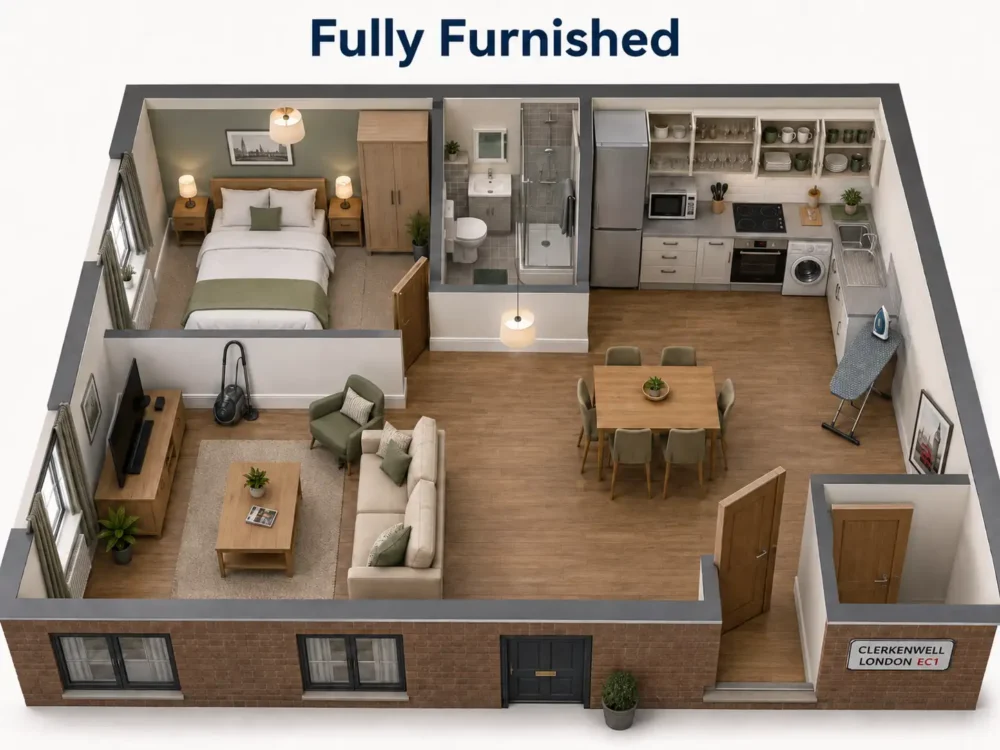 Fully Furnished
- Beds, mattresses, wardrobes and bedside tables in every bedroom
- Sofa(s), armchairs, coffee table, TV stand or media unit in living areas
- Dining table and chairs
- White goods: fridge-freezer, washing machine (often washer-dryer), cooker/oven, hob, microwave
- Crockery, glassware, cutlery and basic kitchen utensils — though this varies; always confirm
- Curtains, blinds and basic light fittings
- Sometimes: TV, vacuum cleaner, iron and ironing board, basic linens
 Part-Furnished
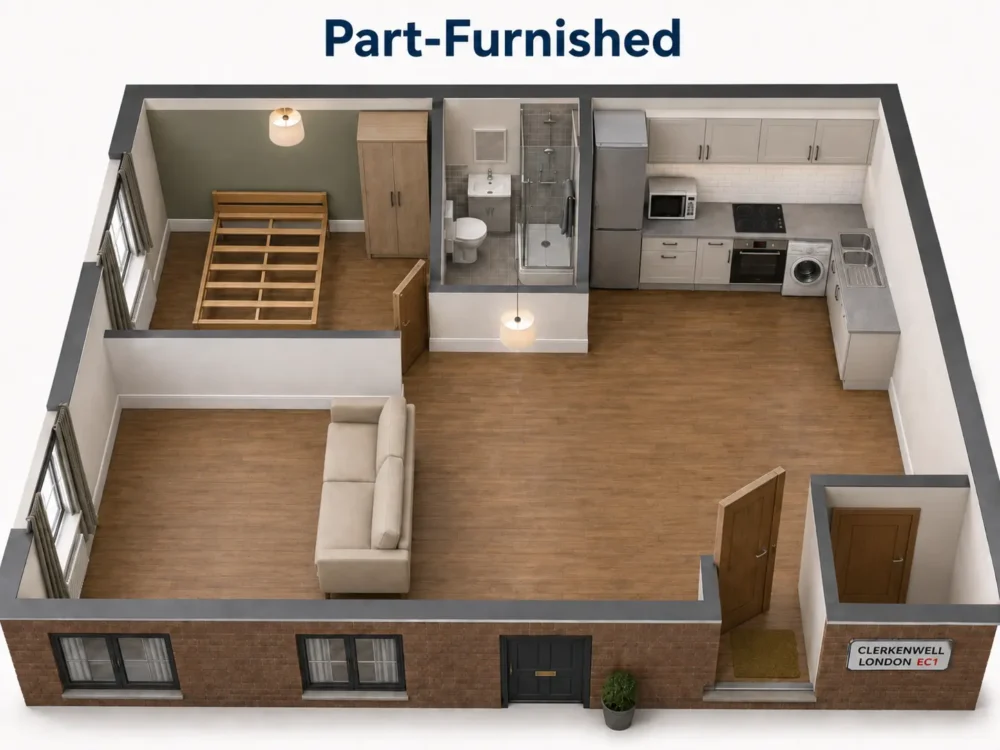 Part-Furnished
- White goods always included (fridge-freezer, washer-dryer, oven, hob)
- Wardrobes (often fitted)
- Curtains/blinds and light fittings
- Sometimes one or two larger items, like a bed frame or sofa
- Tenants bring their own soft furnishings and most furniture
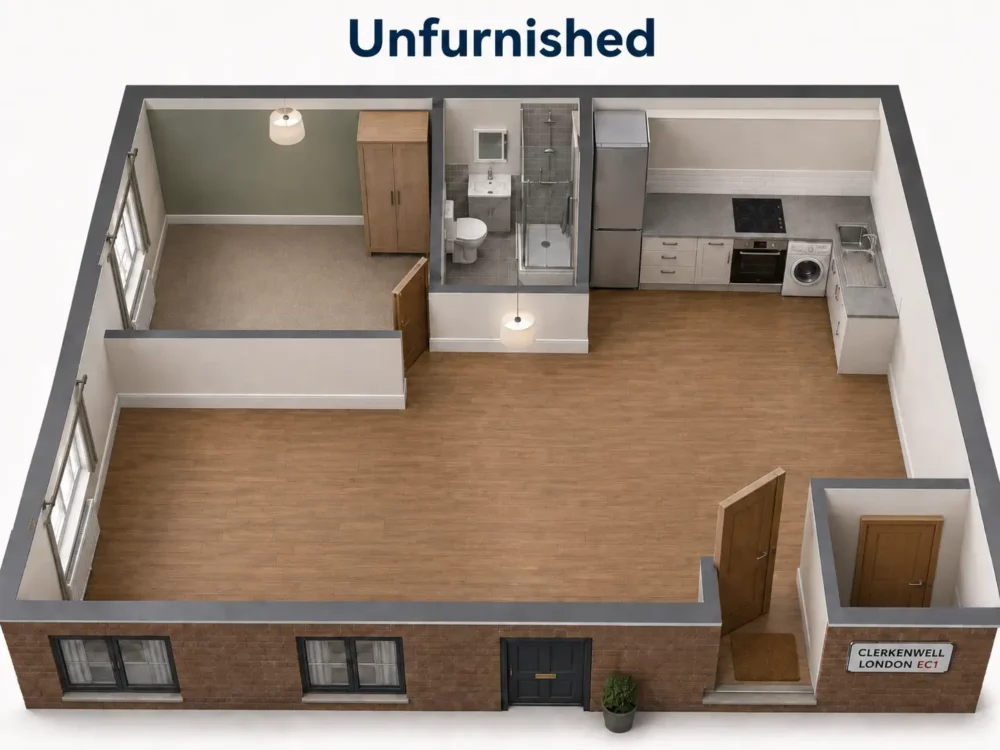
Unfurnished
- White goods usually still included in London (fridge-freezer, washing machine, oven, hob) — this differs from many other countries where “unfurnished” means literally nothing
- Fitted wardrobes if present
- Curtain poles, blinds and light fittings
- No beds, sofas, dining furniture or soft furnishings
The “unfurnished still includes white goods” point is one of the most common surprises for tenants moving from the Continent or the US. In London, an unfurnished flat is almost never bare. For more on what to check on a viewing, see our guide to things to watch for when renting in London.
How the Renters’ Rights Act 2025 Affects the Furnished Decision
This is the single most important update for anyone making a furnished-vs-unfurnished decision in London today. The Renters’ Rights Act 2025 came into force on 1 May 2026, and it changes the structural backdrop for both landlords and tenants:[7]
- Assured Shorthold Tenancies (ASTs) are abolished. All existing ASTs automatically converted to assured periodic tenancies on 1 May 2026. New tenancies use the same model.
- No more fixed terms. Tenancies now run indefinitely, with tenants able to leave on two months’ notice at any time.
- Section 21 “no-fault” evictions are abolished. Landlords must now use Section 8 grounds with a stated reason, and the notice period has increased to four months in many cases.
- Rent in advance is capped. Landlords can only require one month’s rent in advance at the start of a tenancy, plus the deposit.
- Pets cannot be unreasonably refused — and landlords can require pet damage insurance.
- Discrimination against tenants with children or on benefits is formally prohibited.
Why does this matter for furnished vs unfurnished?
- Tenant churn risk has shifted. Tenants can leave on two months’ notice, so the old logic of “furnish heavily to attract a 12-month tenancy” matters less. Furnishing should now be aimed at the right tenant profile, not at locking someone in.
- Inventory and damage protection becomes more important. With no fixed term, tenants may stay much longer than before — and a furnished property accumulates wear differently. Strong inventories, regular check-ins and contents insurance now matter more.
- Furnished properties may see less rapid turnover, which is good for landlords. Many tenants who chose furnished for the convenience of a short stay may now extend, since they have stronger rights to remain. Landlords planning short hold cycles need to adjust.
- Furnished holiday lettings (FHL) tax status is also gone — abolished from April 2025.[8] Short-let furnished landlords no longer benefit from the special tax regime that previously made furnished short lets uniquely attractive. Long-let furnished now has fewer artificial tax advantages versus unfurnished.
For tenants, the practical effect is more security and more flexibility. For landlords, the calculation shifts toward longer-tenure, lower-churn strategies — which often favours unfurnished or part-furnished in larger properties, and well-furnished, well-marketed studios and 1-beds in target segments.
Costs and Compliance for Furnished Landlords
If you’re a landlord considering whether to furnish, here’s what to factor in beyond the headline rent premium:
- Upfront furnishing cost: A reasonable mid-range furnishing of a 1-bed London flat costs £4,000–£8,000. A 2-bed sits around £6,000–£12,000. Higher-end finishes substantially more.
- Replacement and wear: Plan for replacement of soft furnishings every 4–6 years and white goods every 7–10 years. Replacement of Domestic Items Relief lets you offset like-for-like replacements against rental income — but not the initial purchase.[9]
- Fire safety regulations: All furniture you provide must comply with the Furniture and Furnishings (Fire) (Safety) Regulations.[10] Most modern UK-bought furniture meets this; second-hand or imported pieces may not.
- Electrical safety: Annual or periodic checks on appliances you provide (PAT testing for portable items, 5-yearly EICR for fixed electrics) are standard practice and legally required.[11]
- Inventory and check-in: A professional inventory, with photographs and condition notes, is essential for furnished properties. Plan around £150–£300 for an independent inventory clerk.
- Contents insurance: Standard landlord insurance often covers building only. For furnished properties, contents cover for landlord-owned items is a separate add-on.
- Tax on rental income: Rent from furnished and unfurnished properties is taxed the same way. The previous tax advantage of furnished holiday lettings ended April 2025.[8]
For a fuller landlord-side overview, see our guide on how the London rental market works.
Tenant Checklist: Is Furnished Right for You?
Use this simple framework when deciding. If you answer “yes” to three or more, furnished is probably worth the premium. Two or fewer, unfurnished usually wins on overall cost.
- Will you stay in London for less than 18 months?
- Are you moving from overseas without shipping furniture?
- Do you want to be fully set up within 1–2 weeks of arrival?
- Are you renting alone or as a couple in a studio, 1-bed or small 2-bed?
- Is your employer covering rent (corporate posting)?
- Are you a student or under 30?
If you’re moving as a family, planning to stay 2+ years, or already own furniture, unfurnished is almost always the better long-term option — even before you factor in the freedom to personalise.
How London Relocation Can Help
The furnished vs unfurnished decision sits inside a wider set of choices: which area, what size, what budget, what tenant profile, what timeline. We’ve been helping clients navigate these decisions for over 20 years. Where we add the most value:
- One-day accompanied home search — view 6–8 carefully shortlisted properties, furnished and unfurnished, in a single day and secure one before you fly home.
- Remote home search — when you can’t be in London in person.
- Corporate relocation — including dedicated furnished/serviced apartment placement for short-term postings.
- Short-term housing — for stays of less than 6 months, where a fully furnished serviced apartment is usually the right fit.
- Settling-in service — utility setup, council tax, GP registration and everything else.
Frequently Asked Questions
Are furnished apartments more expensive than unfurnished in London?
Often, but not always. Where a furnished premium applies in London — typically in studios and 1-beds aimed at relocation, corporate or student tenants — it usually sits between 10% and 20%. In larger family homes, the premium is often small or non-existent because the target tenants prefer unfurnished. There is no single official Londonwide benchmark, so the most accurate approach is to compare like-for-like properties in the same borough and size band.
How much more can a landlord charge for a furnished rental in London?
Industry estimates suggest landlords can charge up to 15–20% more for a well-furnished property in the right segment — studios and 1-beds in central or relocation-friendly areas. For 2-beds, the premium typically narrows to 5–10%. For 3-bed and larger family homes, there is often no premium at all because the property is more marketable unfurnished.
Should I rent furnished or unfurnished in London?
If you’re staying less than 18 months, moving from overseas, on a corporate posting, or renting a studio or 1-bed, furnished usually makes financial sense despite the premium — the alternative is spending £4,000–£8,000 on furniture you’ll have to sell or ship out. If you’re staying 2+ years, moving as a family, or already own furniture, unfurnished is almost always better.
What does part-furnished mean in London?
Part-furnished in London usually means the landlord provides white goods (fridge-freezer, washer-dryer, oven, hob), curtains and light fittings, often fitted wardrobes, and sometimes one or two larger furniture items like a bed frame or sofa. Tenants bring their own dining furniture, sofas, beds (if not provided) and all soft furnishings. It’s a popular middle ground, especially in 2-bed flats.
Does “unfurnished” in London mean completely empty?
No — and this is one of the most common surprises for tenants moving from abroad. In London, an unfurnished property almost always still includes white goods (fridge-freezer, washing machine, oven, hob), curtains or blinds, light fittings and fitted wardrobes where they exist. What’s missing is furniture: no beds, sofas, dining tables or soft furnishings.
How has the Renters’ Rights Act 2025 changed renting in London?
From 1 May 2026, all assured shorthold tenancies (ASTs) converted to assured periodic tenancies. Fixed-term contracts no longer exist for most private rentals. Section 21 “no-fault” eviction has been abolished — landlords now need a Section 8 ground to end a tenancy. Tenants can leave on two months’ notice at any time. Landlords can only require one month’s rent in advance plus the deposit. Pets cannot be unreasonably refused. These changes apply equally to furnished and unfurnished properties.
Can a landlord ask for more than one month’s rent in advance for a furnished property?
Not under the new rules. From 1 May 2026, the Renters’ Rights Act caps rent in advance at one month for new tenancies, plus the deposit (capped at 5 weeks’ rent, or 6 weeks if annual rent is £50,000+). This applies regardless of whether the property is furnished or unfurnished.
Do landlords need to provide a TV in a furnished London flat?
No, there’s no legal requirement. A TV is a common but not universal inclusion. What’s expected by tenants in 2026 is more often fast broadband-ready setup (a working router or at least pre-installed fibre connection) than a physical TV, since most tenants stream rather than watch broadcast.
Are short-let furnished apartments comparable to long-let furnished apartments?
No, and this is important. Short-term and serviced apartments typically include utilities, council tax, Wi-Fi and weekly cleaning in the headline rent. That makes them look 30–60% more expensive than a comparable unfurnished long-let, but most of the gap is bundled services rather than furniture alone. Always compare like-for-like — long let with long let, short let with short let.
Ready to Find Your London Home?
Whether furnished or unfurnished is right for you ultimately depends on your situation — your timeline, who you’re moving with, whether you’re shipping furniture, and the borough you’re targeting. We help clients work through exactly this question every week, and we’d be happy to help you do the same.
If you’d like personalised advice on the right type of property — and a team that knows which specific buildings and agents are best for furnished vs unfurnished in each borough — get in touch with London Relocation. We’ll match the right home to your move, save you weeks of searching, and handle the paperwork end-to-end.
Welcome to London.
Sources
This article draws on official UK government data, market reports from major property platforms, and industry analysis from leading London letting agencies. All figures cited reflect the most recent available data as of May 2026.
- Office for National Statistics (ONS) — Private rent and house prices, UK: May 2026.
https://www.ons.gov.uk/economy/inflationandpriceindices/bulletins/privaterentandhousepricesuk/may2026 - Zoopla — UK Rental Market Report, March 2026.
https://www.zoopla.co.uk/discover/property-news/rental-market-report/ - Rightmove — Rental Price Tracker.
https://www.rightmove.co.uk/news/rental-price-tracker/ - ONS — Local-level housing prices visualisations (London borough data).
https://www.ons.gov.uk/visualisations/housingpriceslocal/ - Benham & Reeves — Furnished vs unfurnished rental analysis for the London market.
https://www.benhams.com/about-us/news/ - Savills — Furnished vs unfurnished guidance for landlords and tenants.
https://www.savills.co.uk/insight-and-opinion/ - UK Government / Legislation.gov.uk — Renters’ Rights Act 2025.
https://www.legislation.gov.uk/ukpga/2025/26/contents - HMRC / GOV.UK — Abolition of the furnished holiday lettings tax regime (effective April 2025).
https://www.gov.uk/government/publications/abolition-of-the-furnished-holiday-lettings-tax-regime - HMRC / GOV.UK — Replacement of Domestic Items Relief for landlords (PIM3210).
https://www.gov.uk/hmrc-internal-manuals/property-income-manual/pim3210 - UK Government — Furniture and Furnishings (Fire) (Safety) Regulations 1988.
https://www.legislation.gov.uk/uksi/1988/1324/contents/made - GOV.UK — Electrical safety standards in the private rented sector (England) Regulations 2020.
https://www.gov.uk/government/publications/electrical-safety-standards-in-the-private-rented-sector-guidance-for-landlords-tenants-and-local-authorities